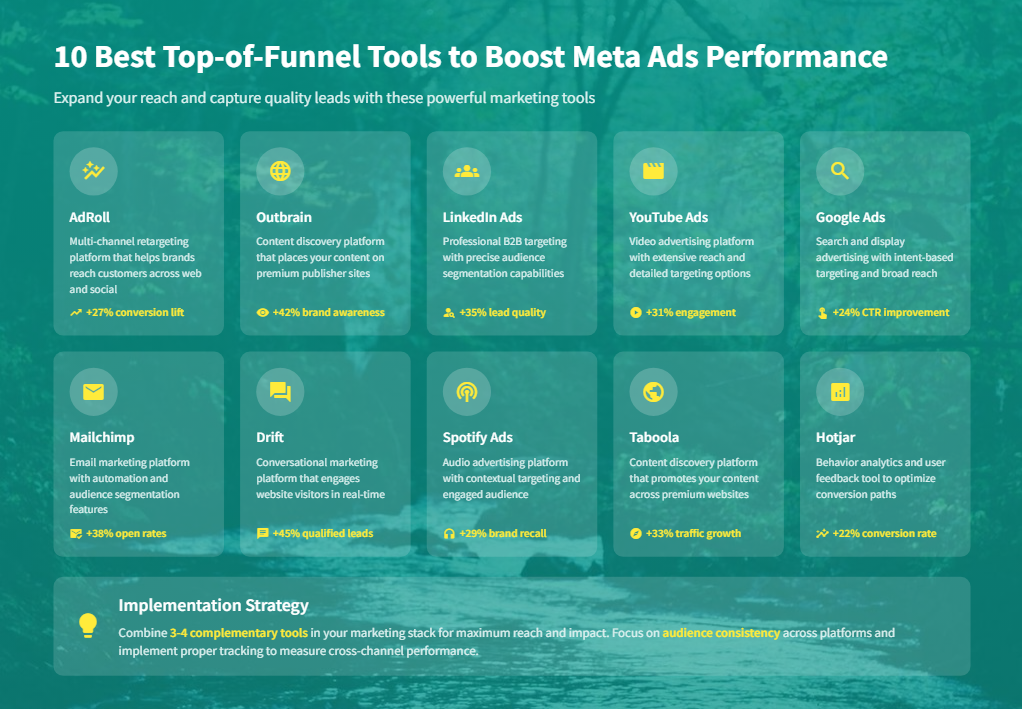
10 Best Top-of-Funnel Tools to Boost Meta Ads Performance
If you’re struggling with cold audiences, you’re not using the right TOF tools.
Many advertisers treat Meta Ads like a slot machine — putting money in and hoping for sales. But if you’re only targeting warm buyers or relying on bottom-of-funnel (BOF) tactics, you’re missing out on the largest pool of potential customers: cold audiences.
That’s where Top-of-Funnel (TOF) tools come in. When used right, they help you grab attention, build trust, and set the stage for conversions later — all while lowering acquisition costs over time.
In this article, we’ll cover:
- What TOF means and why it matters.
- The 10 best TOF tools for Meta Ads.
- How TOF fits into the full TOF → MOF → BOF funnel.
- Real examples you can model today.
What Does “Top-of-Funnel” Mean?
Top-of-Funnel (TOF) is the first stage of your marketing funnel. It’s where you introduce your brand to people who don’t know you yet — your cold audience.
Your goal here isn’t to sell immediately. Instead, it’s to:
- Build brand awareness.
- Create engagement.
- Collect audience data for retargeting.
Think of TOF like a first date: you’re not proposing marriage yet; you’re getting to know each other.
Why TOF Matters in Meta Ads
If you skip TOF and only run direct sales ads to cold audiences, you’ll face:
- Higher CPMs and CPCs.
- Lower ROAS.
- Poor audience trust.
With TOF, you:
- Warm up prospects before asking for a purchase.
- Build remarketing audiences for cheaper middle-of-funnel (MOF) and BOF campaigns.
- Improve Meta’s algorithm learning by feeding it quality engagement signals.
Meta Ads top-of-funnel tools are your leverage here.
10 Best Top-of-Funnel Tools for Meta Ads
Here are the most effective TOF tools to boost cold audience targeting and awareness campaigns.
1. VideoView Campaigns
Why it works:
Videos stop the scroll better than static images, and Meta rewards you with lower CPMs for engaging formats.
How to use:
- Create short, attention-grabbing videos (15–30 seconds).
- Educate, entertain, or inspire — don’t hard-sell.
- Optimize for ThruPlay (15+ seconds) or Video Views to build a retargeting audience.
Example:
A fitness brand runs a 20-second tip video on “3 quick stretches for back pain” to attract health-conscious viewers, then retargets those who watched 50%+ with a product offer.
2. Educational Carousels
Why it works:
Carousels allow you to showcase multiple tips, features, or benefits in a single ad — perfect for storytelling.
How to use:
- Create 4–6 cards with quick, actionable tips.
- Use each card as a mini “teaser” leading viewers to click.
Example:
A skincare company runs a carousel titled “5 Skincare Mistakes You’re Making” with each card focusing on a different mistake.
3. Lead Magnets
Why it works:
Offering something valuable in exchange for contact info builds your warm audience list instantly.
How to use:
- Create a free resource (PDF guide, checklist, mini-course).
- Use Lead Ads or a landing page to collect emails.
- Deliver the lead magnet instantly.
Example:
A tax advisor offers a free “2025 VAT Deduction Checklist” to capture small business owners’ emails for future retargeting.
4. Quizzes & Surveys
Why it works:
Interactive tools increase engagement and help you segment audiences.
How to use:
- Create a quiz related to your niche (e.g., “What’s Your Marketing Personality?”).
- Run a Traffic campaign to the quiz.
- Tag participants for tailored retargeting.
Example:
A home decor store creates “What’s Your Interior Design Style?” quiz and retargets users with product recommendations matching their style.
5. Blog Content Promotion
Why it works:
Promoting blog articles helps you attract problem-aware users searching for solutions.
How to use:
- Share high-value blog posts (tutorials, how-tos, industry insights).
- Use Traffic or Engagement objectives.
- Build custom audiences from page visitors.
Example:
A fuel efficiency site promotes “10 Ways to Save on Petrol in 2025” to attract budget-conscious drivers.
6. Reels & Short-Form Content
Why it works:
Meta is pushing Reels hard, rewarding advertisers with low CPMs and high organic reach.
How to use:
- Create vertical videos (9:16) under 30 seconds.
- Use trends, quick tips, or behind-the-scenes footage.
Example:
A bakery posts a reel of “How Our Croissants Are Made” to entice food lovers before promoting special offers.
7. Influencer Collabs
Why it works:
Leveraging another creator’s audience speeds up trust-building.
How to use:
- Partner with micro-influencers in your niche.
- Run whitelisted ads from their account to cold audiences.
Example:
A supplement brand runs TOF ads through a fitness influencer showing their morning routine with the product.
8. Contest & Giveaway Campaigns
Why it works:
Giveaways drive massive engagement and expand reach quickly.
How to use:
- Offer a high-value prize relevant to your niche.
- Require participants to follow, comment, or submit an entry form.
Example:
A photography store offers “Win a DSLR Camera Kit” giveaway, then retargets entrants with discounted accessories.
9. Engaging Poll Ads
Why it works:
Meta’s poll ads invite interaction, signaling strong engagement to the algorithm.
How to use:
- Add a two-option poll to your ad creative.
- Keep it fun, niche-related, and easy to answer.
Example:
A pet food brand runs a poll: “Wet food or dry food? Vote now!” — then retargets participants with relevant offers.
10. Storytelling Ads
Why it works:
People connect with stories more than direct pitches.
How to use:
- Share your brand’s origin story.
- Highlight a customer transformation.
- Use emotional hooks over product specs.
Example:
A handmade jewelry brand shares the founder’s journey from hobbyist to full-time artisan, attracting craft-loving cold audiences.
How TOF Fits into TOF → MOF → BOF Flow
Here’s how these tools feed the funnel:
Stage 1: Top-of-Funnel (TOF)
Goal: Attract attention & collect data
Tools: Videos, carousels, blog content, quizzes, lead magnets, reels.
Audience: Cold — never interacted with your brand.
Stage 2: Middle-of-Funnel (MOF)
Goal: Build trust & nurture interest
Tools: Retargeting ads, testimonials, case studies, product demos.
Audience: Warm — engaged with TOF content, visited website, downloaded lead magnet.
Stage 3: Bottom-of-Funnel (BOF)
Goal: Convert
Tools: Offer ads, discounts, cart recovery ads, urgency-based campaigns.
Audience: Hot — added to cart, engaged with MOF ads, ready to buy.
Example Funnel Flow:
- TOF: Run a 20-second tip video → build audience of 75% viewers.
- MOF: Retarget viewers with testimonial ads.
- BOF: Serve limited-time discount to MOF clickers.
Example TOF Campaign Blueprint
Let’s walk through a 4-week TOF plan for a fitness brand:
- Week 1–2: Run a video campaign targeting cold audiences with “3 Morning Stretches for Better Posture”.
- Week 3: Launch a lead magnet “Free 7-Day Posture Challenge”.
- Week 4: Retarget those who signed up with “Join Our Full Training Program – Limited Offer”.
This approach builds trust first, then transitions smoothly into offers.
TOF Metrics to Watch
To know if your TOF tools are working, track:
- CPM (Cost per 1,000 impressions) — Lower is better for awareness.
- CTR (Click-through rate) — Signals content relevance.
- Video watch % — Higher means better engagement.
- Audience growth — Size of remarketing lists over time.
Common TOF Mistakes to Avoid
Mistake 1: Selling Too Soon
Cold audiences need warming up before buying.
Fix: Focus on value, not offers, in TOF ads.
Mistake 2: Using One Creative Forever
Ad fatigue kills performance quickly.
Fix: Rotate creatives every 2–4 weeks.
Mistake 3: Ignoring Retargeting
TOF only works if followed by MOF/BOF.
Fix: Always set up sequential targeting.
Final Take
Meta Ads cold audience targeting is more effective when you use a variety of TOF tools. Whether it’s video, quizzes, or giveaways, the key is to engage, not sell — at least not yet.
By strategically warming up prospects, you make MOF and BOF campaigns much more profitable, improve ROAS, and build lasting customer relationships.